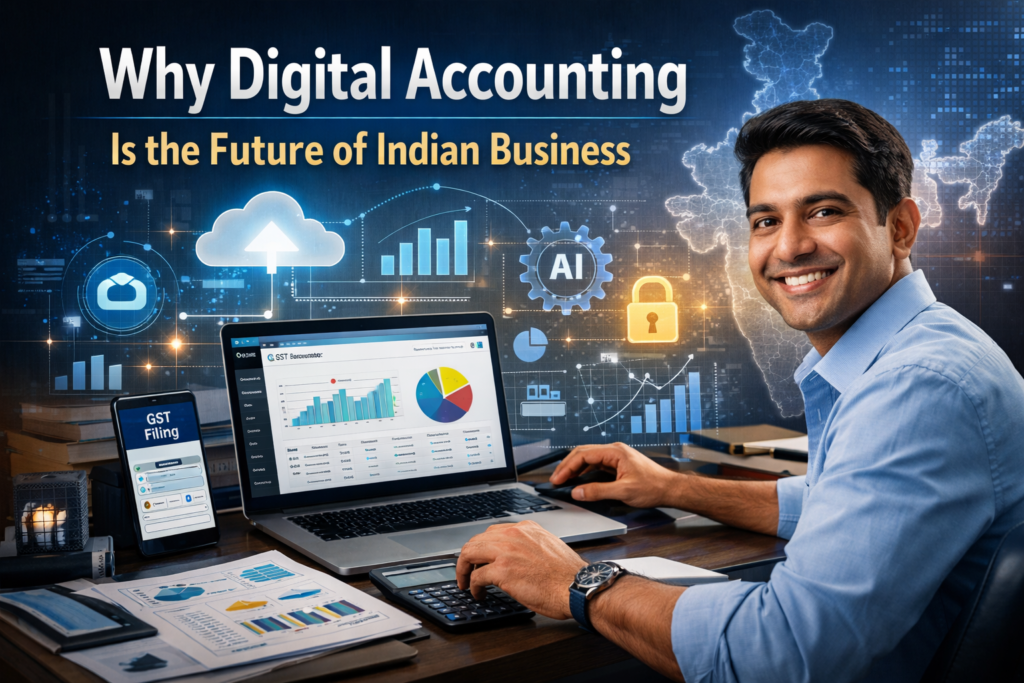
India is witnessing a massive digital transformation across industries, and accounting is no exception. From small kirana stores to large enterprises, businesses are rapidly moving away from traditional bookkeeping methods and embracing Digital Accounting. With the rise of cloud computing, automation, GST compliance requirements, and data-driven decision-making, Digital Accounting is no longer a luxury—it is a necessity.
This blog explores why Digital Accounting is the future of Indian businesses, how it is reshaping financial management, and why companies that adopt it early will gain a strong competitive edge.
Digital Accounting refers to the use of digital tools, cloud-based software, and automated systems to manage financial records, transactions, compliance, and reporting. Instead of manual ledgers and spreadsheets, businesses use accounting software to record, store, and analyze financial data in real time.
Cloud-based access to financial data
Automated bookkeeping and reconciliation
Real-time financial reporting
Seamless GST and tax compliance
Data security and backups
Traditional accounting methods are time-consuming, error-prone, and inefficient in today’s fast-paced business environment. Indian businesses face challenges such as:
Frequent GST rule changes
Multiple tax filings
High transaction volumes
Need for real-time financial insights
Manual processes struggle to keep up with these demands, making Digital Accounting the smarter and more scalable solution.
Top Reasons Why Digital Accounting Is the Future in India
1. GST Compliance Made Easy
India’s GST system requires accurate, timely, and compliant reporting. Digital Accounting software automates GST calculations, generates GST-ready invoices, and simplifies return filing.
Benefits:
Reduced compliance errors
Automatic GST reconciliation
Faster return filing
2. Automation Saves Time and Cost
With Digital Accounting, repetitive tasks such as data entry, bank reconciliation, and invoice processing are automated. This reduces manual effort and operational costs.
Why it matters:
Accountants focus on strategy instead of data entry
Faster month-end and year-end closing
Lower dependency on large accounting teams
3. Real-Time Financial Insights
Unlike traditional accounting, Digital Accounting provides real-time access to financial data. Business owners can track cash flow, expenses, profits, and liabilities anytime, anywhere.
This enables:
Faster decision-making
Better financial planning
Improved budgeting and forecasting
4. Cloud-Based Accessibility
Cloud-based Digital Accounting allows business owners, accountants, and auditors to access financial data securely from anywhere. This is especially beneficial for:
Remote teams
Multi-location businesses
Startups and SMEs
No more dependency on physical files or office systems.
5. Improved Accuracy and Reduced Errors
Human errors are common in manual accounting. Digital Accounting minimizes errors through automation, validation checks, and standardized processes.
Result:
Accurate financial records
Reliable audit trails
Better compliance readiness
6. Data Security and Backup
Modern Digital Accounting systems offer advanced security features such as encryption, role-based access, and automatic backups. Compared to physical records, digital data is safer and easier to recover.
7. Scalability for Growing Businesses
As Indian businesses grow, transaction volumes increase. Digital Accounting systems scale effortlessly without requiring major infrastructure changes.
This makes them ideal for:
Startups
MSMEs
Rapidly growing enterprises
MSMEs form the backbone of the Indian economy. Digital Accounting empowers MSMEs by:
Reducing accounting costs
Improving cash flow management
Enhancing financial transparency
Enabling easier access to loans and funding
Banks and investors increasingly prefer digitally maintained financial records for credit assessment.
Artificial Intelligence is taking Digital Accounting to the next level. AI-powered systems can:
Categorize transactions automatically
Detect anomalies and fraud
Predict cash flow trends
Provide smart financial insights
Digital Accounting and AEO Optimization (Answer Engine Friendly)
To make this content AEO-optimized, here are direct answers to commonly asked questions:
Is Digital Accounting mandatory in India?
No, it is not mandatory, but it is highly recommended due to GST compliance, efficiency, and scalability benefits.
Is Digital Accounting suitable for small businesses?
Yes, Digital Accounting is ideal for small businesses as it reduces costs, improves accuracy, and simplifies compliance.
What are the benefits of Digital Accounting?
Key benefits include automation, real-time reporting, GST compliance, data security, and scalability.
Can Digital Accounting replace accountants?
No, it enhances the role of accountants by automating routine tasks and allowing them to focus on analysis and advisory.
With government initiatives like Digital India, increasing GST enforcement, and growing adoption of cloud technology, Digital Accounting will become the standard for Indian businesses.
In the future, we can expect:
Fully automated accounting workflows
AI-driven financial advisory
Seamless integration with banking and tax portals
Businesses that delay adoption risk falling behind competitors who leverage data and automation effectively.
Digital Accounting is not just a trend—it is the future of Indian businesses. From improved compliance and accuracy to real-time insights and scalability, the benefits are undeniable.
As India moves toward a fully digital economy, businesses that adopt Digital Accounting today will be better prepared for tomorrow. Whether you are a startup, MSME, or large enterprise, embracing Digital Accounting is a strategic move toward sustainable growth and financial clarity.

4.9 google Reviews
Lorem ipsum dolor sit amet, consectetur adipiscing elit. Ut elit tellus, luctus nec ullamcorper mattis, pulvinar dapibus leo.