In today’s fast-paced business environment, a (BMS) is essential for companies aiming to streamline operations and improve efficiency. With the rise of digital solutions, SMEs and startups are increasingly turning to these systems to manage their processes effectively. This blog will explore the key features and benefits of business management systems, providing insights into how they can transform your operations.
A Business Management System is a comprehensive software solution that integrates various business functions into a unified platform. It helps organizations manage core processes such as finance, human resources, supply chain, and customer relationships. By using a BMS, businesses can enhance productivity, improve communication, and make informed decisions based on real-time data. Companies looking to optimize their operations can learn about business management software to find the right solution for their needs.
Key Components of a Business Management System
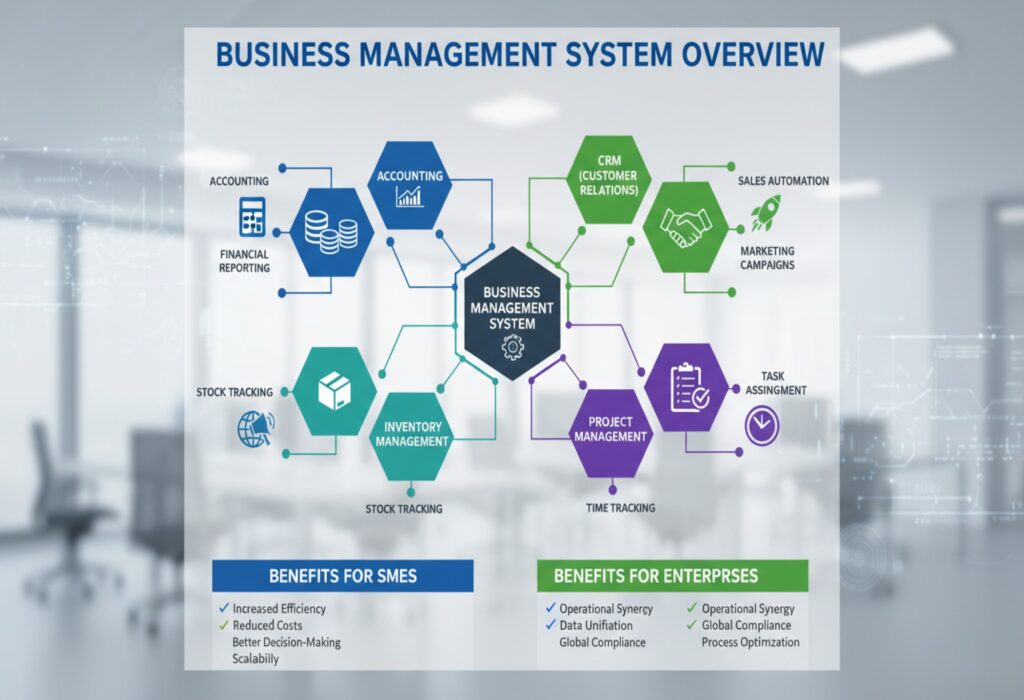
Business management systems come equipped with a variety of features that cater to different business needs. Here are some of the most important features to consider:
Accounting & Finance Management
A robust BMS includes accounting features that help manage financial transactions, budgeting, and reporting. This allows businesses to maintain accurate financial records and comply with regulations.
CRM Integration
Customer relationship management CRM integration is crucial for managing customer interactions and data. A BMS that incorporates CRM capabilities helps businesses track leads, manage sales pipelines, and improve customer service.
Inventory Management
Effective inventory management ensures that businesses maintain optimal stock levels, reducing costs and preventing stockouts. A BMS can automate inventory tracking and reorder processes.
HR & Payroll
Managing human resources and payroll can be time-consuming. A BMS simplifies these processes by automating employee records, payroll calculations, and compliance with labor laws.
Workflow Automation
Workflow automation features streamline routine tasks, allowing employees to focus on more strategic activities. This can lead to significant productivity gains.
Cloud Access & Security
Cloud-based business management systems provide remote access to critical data while ensuring robust security measures are in place to protect sensitive information. Businesses using explore ERP solutions for SMEs can leverage these advantages effectively.
Reporting & Analytics
Advanced reporting and analytics capabilities enable businesses to generate insights from their data, facilitating better decision-making. This feature is vital for tracking performance metrics and identifying areas for improvement.
Multi-user Collaboration
A BMS supports collaboration among team members by allowing multiple users to access and work on the same platform simultaneously. This fosters teamwork and enhances communication.
Implementing a Business Management System can lead to numerous advantages for organizations. Here are some of the major benefits:
Improved Productivity
By automating routine tasks and integrating various business functions, a BMS significantly enhances productivity. Employees can spend less time on administrative work and more on strategic initiatives.
Cost Reduction
A BMS can help identify inefficiencies and reduce operational costs. By streamlining processes, businesses can save money on labor and resources.
Better Decision-Making
Access to real-time data and analytics allows leaders to make informed decisions quickly. This agility is crucial in a competitive business landscape.
Real-Time Data Access
With a centralized system, businesses can access critical data anytime, anywhere. This capability is essential for remote teams and enhances operational flexibility.
Enhanced Customer Management
A BMS improves customer relationship management by centralizing customer data and interactions. This leads to better service and higher customer satisfaction.
Business Scalability
As businesses grow, their needs evolve. A BMS can scale with the organization, providing the necessary tools and features to support growth. Companies looking to discover business automation tools can find solutions that adapt to their changing requirements.
Many businesses have successfully implemented Business Management Systems to enhance their operations. For instance, a retail company may use a BMS to integrate inventory management with sales data, allowing for real-time stock level updates and improved customer service. Similarly, a service-based business might automate its HR and payroll processes, freeing up valuable resources for strategic planning.
Case Study: A Manufacturing Firm
A manufacturing firm implemented a BMS to streamline its production processes. By integrating inventory management and accounting, the company reduced waste and improved cash flow. The automation of workflows allowed employees to focus on quality control, resulting in a 20% increase in production efficiency.
Case Study: A Startup
A startup utilized a BMS to manage its customer relationships and sales processes. The CRM integration enabled the team to track leads effectively, resulting in a 30% increase in sales conversions within six months. This demonstrates how a BMS can significantly impact a company’s bottom line.
Businesses looking to understand cloud business management systems can find numerous success stories that highlight the transformative power of these solutions.
Traditional management methods often rely on manual processes, leading to inefficiencies and increased error rates. In contrast, automated systems streamline operations, reducing the time spent on repetitive tasks.
Comparison Table
| Aspect | Traditional Methods | Automated Systems |
|—————————–|—————————|—————————|
| Efficiency | Low | High |
| Error Rate | High | Low |
| Data Accessibility | Limited | Instant |
| Collaboration | Challenging | Seamless |
| Scalability | Difficult | Easy |
The shift from traditional methods to automated systems is becoming increasingly necessary as businesses seek to remain competitive in 2026.
Recent data shows that by 2026, over 70% of SMEs are expected to adopt some form of business management software. This trend highlights the growing recognition of the need for integrated solutions in managing complex business operations.
Key Trends
Cloud-based business management systems are revolutionizing the way SMEs operate. They provide access to advanced features without the need for significant upfront investments in hardware and software.
Benefits of Cloud Solutions
The adoption of cloud-based systems is a game-changer for SMEs looking to compete in the digital age.
In conclusion, adopting a Business Management System can significantly enhance your organization’s efficiency and productivity. By leveraging the key features and benefits discussed, businesses can streamline their operations and make more informed decisions. As we move towards 2026, embracing digital management solutions is not just an option; it’s a necessity for staying competitive.
Take the first step in transforming your business today by exploring the right management system for your needs. Embrace the future of business management and unlock your organization’s full potential.

4.9 google Reviews
Lorem ipsum dolor sit amet, consectetur adipiscing elit. Ut elit tellus, luctus nec ullamcorper mattis, pulvinar dapibus leo.