
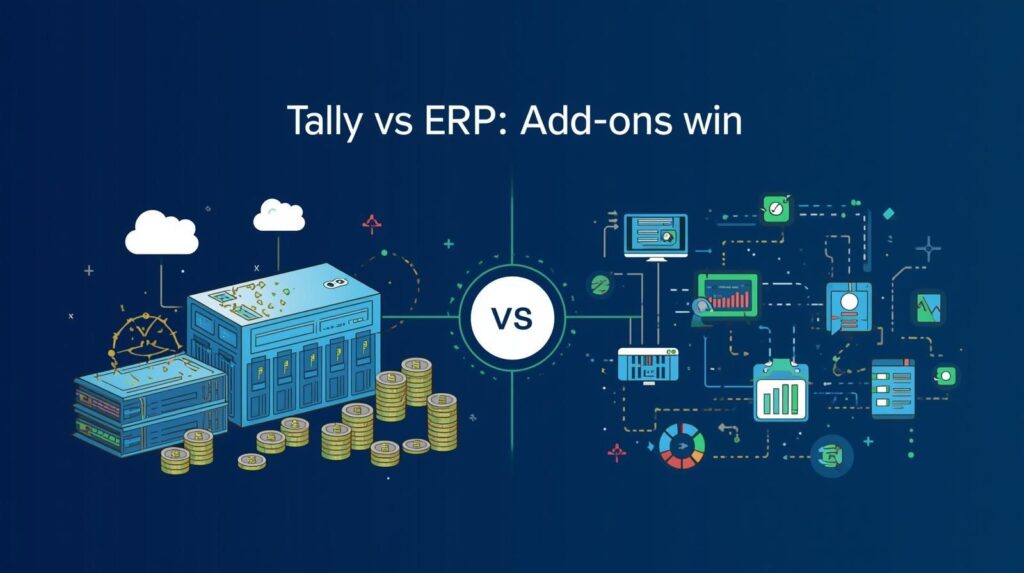
Tally vs ERP Systems: Why Add-Ons Beat Expensive Upgrades is a critical decision for growing businesses. Tally is a powerful accounting software designed for small to mid-sized businesses, focusing on financial management, inventory, and compliance. ERP (Enterprise Resource Planning) systems are comprehensive platforms that integrate multiple business functions—accounting, HR, supply chain, CRM, and more—into one unified solution.
While ERP systems offer extensive capabilities, they come with substantial costs, complex implementations, and lengthy deployment times. Tally, enhanced with strategic add-ons, provides a cost-effective alternative that delivers enterprise-level functionality without breaking the bank.
Tally’s add-on ecosystem transforms the base software into a customizable powerhouse. Here’s how it works:
Core Functionality: Tally vs ERP provides robust accounting, GST compliance, inventory management, and financial reporting as standard features.
Modular Add-Ons: Businesses can integrate specific add-ons based on their unique requirements—CRM modules, advanced analytics, e-commerce integration, payroll extensions, or industry-specific tools.
Seamless Integration: Add-ons plug directly into Tally’s architecture, ensuring data consistency and eliminating the need for separate systems.
Scalable Growth: As business needs evolve, companies can add new modules incrementally rather than investing in complete system overhauls.
Cost-Effective Customization: Instead of paying for unused ERP features, businesses invest only in functionalities they actually need.
When evaluating Tally vs ERP systems, the add-on approach presents several breakthrough advantages:
Financial Efficiency: Full ERP implementations can cost anywhere from $50,000 to several million dollars. Tally with add-ons typically requires investments of just a few thousand dollars, delivering 70-80% of ERP functionality at 10-20% of the cost.
Rapid Deployment: ERP implementations often take 6-18 months. Tally add-ons can be deployed in days or weeks, minimizing business disruption.
Lower Risk: Expensive ERP upgrades represent significant financial risk. If implementation fails or doesn’t meet expectations, losses are substantial. Tally add-ons offer low-risk experimentation with minimal financial exposure.
Familiar Interface: Teams already using Tally face minimal learning curves with add-ons. ERP systems require extensive retraining, leading to productivity losses and resistance.
Flexibility: Businesses can easily switch or remove add-ons that don’t work. ERP systems lock companies into long-term contracts and rigid architectures.

The debate of Tally vs ERP systems: why add-ons beat expensive upgrades becomes clear when examining practical applications:
Manufacturing: Production tracking add-ons, bill of materials management, and quality control modules extend Tally’s capabilities without full ERP costs.
Retail & E-commerce: Point-of-sale integration, online store connectivity, and multi-location inventory management enhance Tally for modern retail operations.
Service Industries: Project management add-ons, timesheet tracking, and client billing modules transform Tally into a comprehensive service business solution.
Distribution: Advanced warehouse management, logistics tracking, and multi-branch consolidation add-ons support complex distribution networks.
Healthcare & Education: Industry-specific add-ons for patient billing, fee management, and regulatory compliance adapt Tally to specialized sectors.
Cost Savings: Businesses save 60-90% compared to full ERP implementations while achieving similar outcomes.
Faster ROI: With lower investment and quicker deployment, return on investment typically occurs within 3-6 months versus 2-3 years for ERP systems.
Business Continuity: Minimal disruption to daily operations during implementation ensures revenue streams remain unaffected.
Scalability: Start small and scale gradually based on actual business growth rather than anticipated needs.
Local Support: Tally’s extensive partner network in India and other markets provides accessible, affordable support compared to expensive ERP consultants.
Data Ownership: Complete control over data without vendor lock-in or cloud dependency concerns.
Customization Freedom: Easier to develop custom add-ons for unique business processes compared to modifying rigid ERP frameworks.
While Tally vs ERP systems comparison favors add-ons for many businesses, some challenges exist:
Integration Complexity: Multiple add-ons from different vendors may require coordination to ensure seamless data flow.
Feature Limitations: Extremely large enterprises with complex, global operations may eventually outgrow Tally’s architecture.
Add-On Quality Variation: Not all add-ons are created equal. Thorough vetting of vendors and solutions is essential.
Support Fragmentation: Multiple add-on vendors mean multiple support relationships to manage.
Upgrade Compatibility: When Tally releases major updates, add-ons must be updated accordingly, potentially causing temporary disruptions.
The future strongly favors modular, flexible solutions over monolithic tally vs ERP systems:
AI-Powered Add-Ons: Machine learning modules for predictive analytics, automated bookkeeping, and intelligent forecasting are emerging.
Cloud Integration: Hybrid solutions combining Tally’s desktop stability with cloud-based add-ons for remote access and collaboration.
API Ecosystem Growth: Expanding connectivity between Tally and third-party applications creates unlimited customization possibilities.
Industry-Specific Solutions: More specialized add-ons targeting niche industries will reduce the need for expensive custom ERP development.
Mobile Extensions: Add-ons enabling full mobile functionality transform Tally vs ERP into an anywhere-accessible business management tool.
For small to mid-sized businesses, the choice between Tally vs ERP systems: why add-ons beat expensive upgrades is increasingly clear. Tally’s add-on ecosystem delivers enterprise-level capabilities with a fraction of the cost, risk, and complexity of traditional ERP implementations.
By strategically selecting add-ons that match specific business needs, companies achieve customized solutions without paying for unnecessary features. The result is faster implementation, better ROI, and the flexibility to adapt as business requirements evolve.
Rather than viewing software as an all-or-nothing decision, modern businesses are embracing modular approaches that grow with them. For most organizations, Tally enhanced with targeted add-ons represents the smart, sustainable path forward.