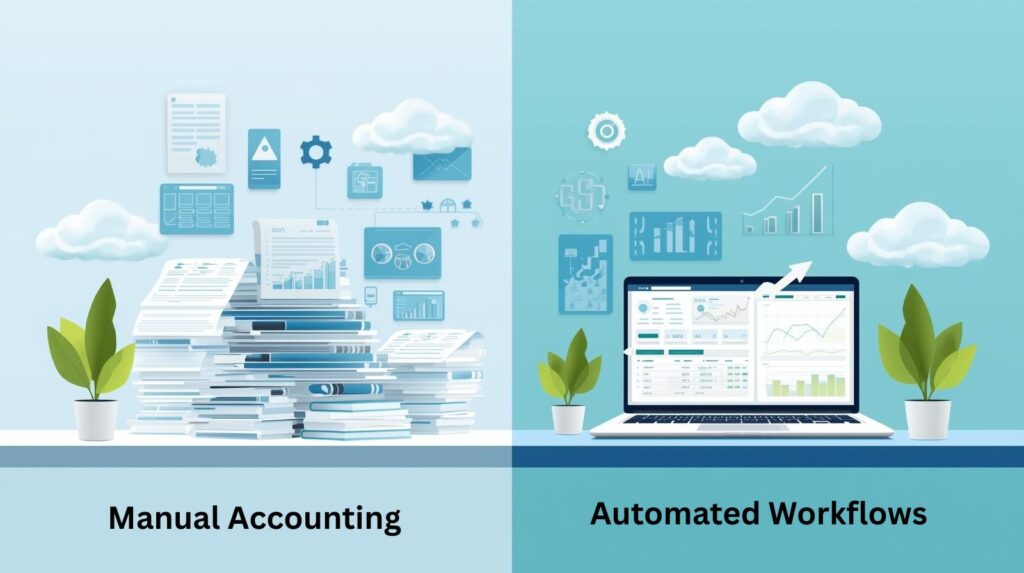
In today’s fast-paced business environment, streamlined financial management is essential. “From manual accounting to automated workflows” describes the transformative shift from traditional, time-consuming accounting methods towards advanced, technology-driven processes known as automated accounting workflows. This change dramatically enhances accuracy, efficiency, and business insight.
Automated accounting workflows leverage software solutions and integration tools to manage repetitive accounting tasks, data entry, and reporting. At its core, this technology combines accounting process automation with intelligent software that reduces errors and accelerates financial operations.
Key components include:
Accounting Software Integration: Connects various financial platforms for seamless data exchange.
Data Extraction Tools: Automate ingestion and categorization of receipts, invoices, and transactions.
Workflow Engines: Manage task sequencing and approval processes automatically.
Real-Time Reporting: Generate financial insights and dashboards instantly.
Machine Learning: Improves accuracy by learning transactional patterns.
By transforming manual to automated accounting, businesses reduce reliance on tedious tasks while building workflows that continuously adapt to operational needs.
Example 1: Ecommerce – Streamlining Order-to-Cash Process
An online retail company struggled with delayed invoice processing and frequent billing errors due to manual accounting tasks.
Context: Ecommerce business facing slow invoicing and revenue recognition delays.
Workflow: Automated software extracts order data, generates invoices, and routes approvals without manual intervention.
Results: Shorter billing cycles and improved cash flow accuracy.
Example 2: Manufacturing – Automated Payroll and Expense Management
A manufacturing firm faced challenges managing complex payroll calculations and expense reimbursement manually.
Context: Company with high employee volume and diverse payroll needs.
Workflow: Accounting automation tools calculate wages, deduct taxes, and process expense claims automatically.
Results: Reduced payroll errors and faster reimbursement cycles.
Example 3: Accounting Firm – Scaling Client Onboarding
An accounting services provider needed to efficiently onboard clients and handle their monthly bookkeeping without increasing headcount.
Context: Service firm managing numerous small business clients with manual data entry bottlenecks.
Workflow: Cloud-based automated workflows extract client financial data and prepare initial reports instantly.
Results: Faster client onboarding and increased capacity without additional staff.
Enhanced Accuracy: Minimizes human error in data entry and calculation.
Time Savings: Frees accounting teams from repetitive tasks to focus on analysis and strategy.
Cost Efficiency: Reduces labor costs associated with manual bookkeeping.
Faster Close Cycles: Quickens month-end reporting and compliance.
Scalability: Supports growing transaction volumes without proportional staff increases.
Improved Compliance: Automated audit trails create transparent financial records.
Even with powerful benefits, transitioning from manual to automated accounting presents challenges:
Initial Setup Complexity: Integrating diverse legacy systems can be time-consuming.
Data Privacy Concerns: Sensitive financial data requires robust security safeguards.
Accuracy Dependency: Automation depends on correct initial data; garbage-in, garbage-out risks remain.
Change Management: Employees may resist adapting to new workflows.
Cost of Technology: Upfront investment and ongoing licensing fees can be barriers.
Understanding these limitations enables realistic planning and targeted mitigation strategies.
Advances like artificial intelligence and cloud computing are propelling accounting process automation forward:
AI-Driven Anomaly Detection: Automatically flags suspicious transactions.
Blockchain Integration: Enhances transaction transparency and audit accuracy.
Voice-Enabled Accounting: Enables hands-free data querying and entry.
Robotic Process Automation (RPA): Handles rule-based tasks across systems effortlessly.
Predictive Analytics: Provides forecasting based on automated data trends.
Businesses embracing these technologies will gain deeper insights, stronger controls, and greater agility in financial management.

4.9 google Reviews
Lorem ipsum dolor sit amet, consectetur adipiscing elit. Ut elit tellus, luctus nec ullamcorper mattis, pulvinar dapibus leo.