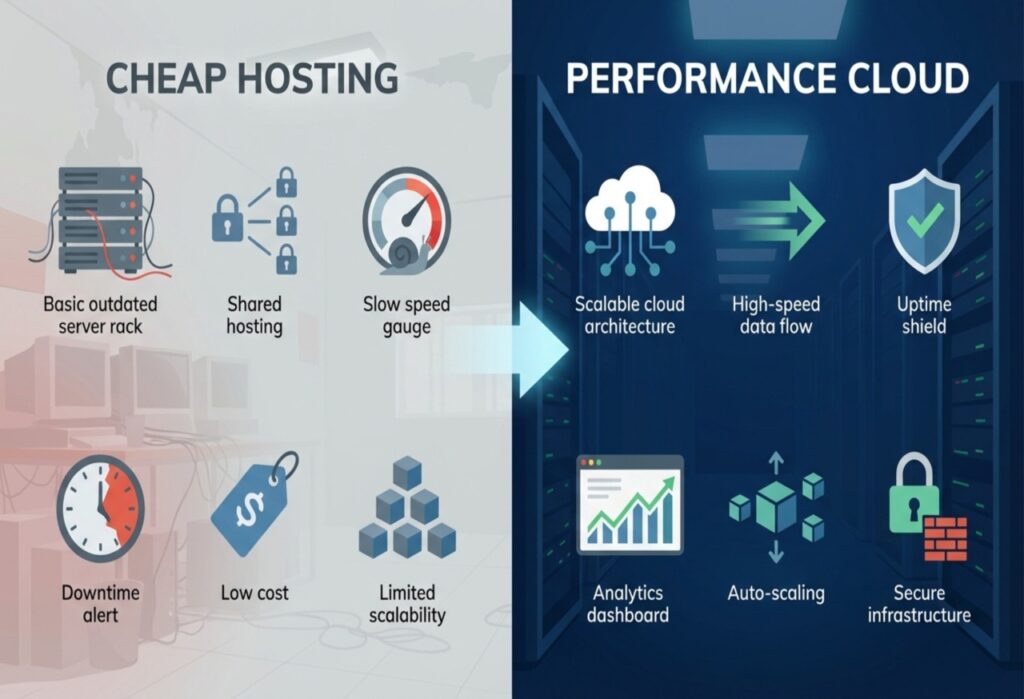
The Indian digital landscape is witnessing a fundamental transformation. Businesses across sectors are abandoning traditional cheap hosting solutions in favor of performance cloud infrastructure. This migration isn’t merely a technological upgrade—it represents a strategic shift in how companies approach digital operations, customer experience, and competitive positioning in an increasingly digital-first economy.
For years, Indian startups and SMEs gravitated toward affordable web hosting solutions, prioritizing cost over capability. The logic seemed sound: why invest heavily in infrastructure when you’re testing market viability? However, this penny-wise approach has proven pound-foolish as businesses scale.
The hidden costs of cheap shared hosting become apparent when websites crash during traffic spikes, load times exceed customer patience thresholds, and security vulnerabilities expose sensitive data. A recent study revealed that 53% of mobile users abandon websites that take longer than three seconds to load. For Indian e-commerce businesses competing with giants like Amazon and Flipkart, these performance gaps translate directly into lost revenue.
Consider the case of a Bangalore-based fashion retailer who experienced their website collapsing during a flash sale event, resulting in approximately ₹12 lakhs in lost transactions within four hours. The culprit? Their ₹299/month shared hosting package couldn’t handle the concurrent user load. This scenario plays out repeatedly across Indian businesses still relying on traditional budget hosting providers.
Cloud hosting solutions have evolved from luxury infrastructure to business necessity. Unlike conventional hosting where resources are fixed and shared, performance cloud platforms offer elastic scalability, dedicated resources, and architecture designed for reliability. The difference isn’t incremental—it’s transformational.
Modern cloud infrastructure provides businesses with automatic scaling capabilities that match resource allocation to real-time demand. During normal traffic periods, companies pay only for baseline resources. When promotional campaigns drive traffic surges, the infrastructure automatically provisions additional computing power, ensuring consistent performance without manual intervention or service disruption. This elasticity addresses one of the most significant challenges facing Indian businesses: unpredictable traffic patterns. Whether it’s festival season shopping spikes, viral social media campaigns, or regional market expansions, cloud server hosting adapts seamlessly while maintaining optimal performance standards.
Several converging trends are accelerating the migration from cheap web hosting to enterprise-grade cloud solutions in India:
Digital-First Consumer Expectations
Indian consumers increasingly expect experiences comparable to global standards. Mobile internet penetration has reached 820 million users, creating a digitally savvy customer base with zero tolerance for slow, unreliable websites. Businesses compete not just with local rivals but with international benchmarks for speed, security, and user experience.
E-commerce and Online Services Growth
The Indian e-commerce market is projected to reach $350 billion by 2030. This explosive growth demands infrastructure capable of handling millions of concurrent transactions, real-time inventory management, and personalized customer experiences—capabilities far beyond traditional shared hosting environments.
Regulatory and Compliance Requirements
Data localization mandates and privacy regulations have made secure cloud hosting essential rather than optional. The Digital Personal Data Protection Act requires businesses to implement robust security measures, backup protocols, and data governance frameworks that cheap hosting providers simply cannot deliver.
Competitive Pressure and Brand Perception
Website performance has become a brand differentiator. Companies recognize that their digital infrastructure directly impacts brand perception. A three-second delay in page load time can reduce conversions by up to 40%, while consistent uptime and fast response times build trust and credibility.
While performance cloud hosting carries higher nominal costs than budget alternatives, total cost of ownership calculations reveal a different story. When factoring in downtime costs, lost conversions, developer productivity, security incidents, and scalability limitations, premium cloud infrastructure often proves more economical.
A Mumbai-based SaaS company calculated that their previous ₹500/month hosting solution was actually costing them ₹85,000 monthly in lost subscriptions due to unreliable service and poor API response times. After migrating to a managed cloud platform at ₹15,000/month, they experienced 99.99% uptime and recovered the lost revenue while improving customer satisfaction scores by 47%.
The equation shifts further when considering opportunity costs. Developer time spent troubleshooting hosting-related issues, managing server configurations, or implementing workarounds for infrastructure limitations represents significant hidden expenses. Managed cloud services eliminate these burdens, allowing technical teams to focus on product development and innovation.
The technical superiority of performance cloud platforms translates into measurable business advantages:
Speed and Performance Optimization: Content delivery networks, SSD storage, optimized caching mechanisms, and server-side optimizations ensure millisecond response times. For Indian businesses targeting both domestic and international markets, global cloud infrastructure with regional data centers ensures low-latency access regardless of user location.
Security and Reliability: Enterprise-grade cloud hosting includes DDoS protection, automated backups, disaster recovery capabilities, and compliance certifications. These features protect businesses from both technical failures and security threats that could devastate companies relying on basic hosting packages.
Scalability Without Friction: Seasonal businesses, content publishers experiencing viral traffic, and rapidly growing startups benefit from infrastructure that scales instantly. This flexibility eliminates the traditional trade-off between over-provisioning (and overpaying) for capacity versus risking performance degradation during peak periods.
Advanced Features and Integration: Modern cloud platforms offer integrated services including database management, AI/ML capabilities, analytics tools, and automated deployment pipelines. These features accelerate development cycles and enable sophisticated functionality impossible with traditional cheap web hosting.
Forward-thinking Indian businesses recognize that cloud migration represents more than operational improvement—it’s strategic brand positioning. Companies advertising their cloud-based infrastructure signal reliability, innovation, and customer-centricity to both B2C consumers and B2B clients.
This positioning becomes particularly valuable in competitive sectors where technical capabilities differentiate market leaders from followers. Fintech companies, healthcare platforms, edtech providers, and enterprise software vendors leverage high-performance cloud hosting as evidence of their commitment to service quality and data security.
The transition from cheap hosting to performance cloud need not be disruptive. Cloud migration strategies can be implemented gradually, starting with critical workloads and expanding as teams develop cloud-native competencies. Many cloud service providers offer migration support, ensuring minimal downtime and knowledge transfer during the transition.
For businesses evaluating this shift, the question isn’t whether to migrate but when and how. Market leaders have already made the move, establishing competitive advantages in speed, reliability, and customer experience. Companies delaying this transition risk falling behind competitors who’ve embraced modern cloud infrastructure to deliver superior digital experiences.
The migration from cheap hosting to performance cloud represents Indian businesses’ recognition that digital infrastructure is strategic investment, not operational expense. As competition intensifies across every sector, the companies succeeding will be those that prioritize customer experience, operational reliability, and scalable growth—all enabled by enterprise cloud hosting.
The market has spoken clearly: budget hosting solutions designed for static websites and low-traffic blogs cannot support the dynamic, customer-centric, always-available digital experiences today’s Indian consumers expect. Performance cloud platforms aren’t the future—they’re the present competitive standard. Businesses still operating on legacy cheap web hosting aren’t saving money; they’re accumulating technical debt and competitive disadvantage that grows more expensive to resolve with each passing quarter.

4.9 google Reviews
Lorem ipsum dolor sit amet, consectetur adipiscing elit. Ut elit tellus, luctus nec ullamcorper mattis, pulvinar dapibus leo.