Upfront Costs
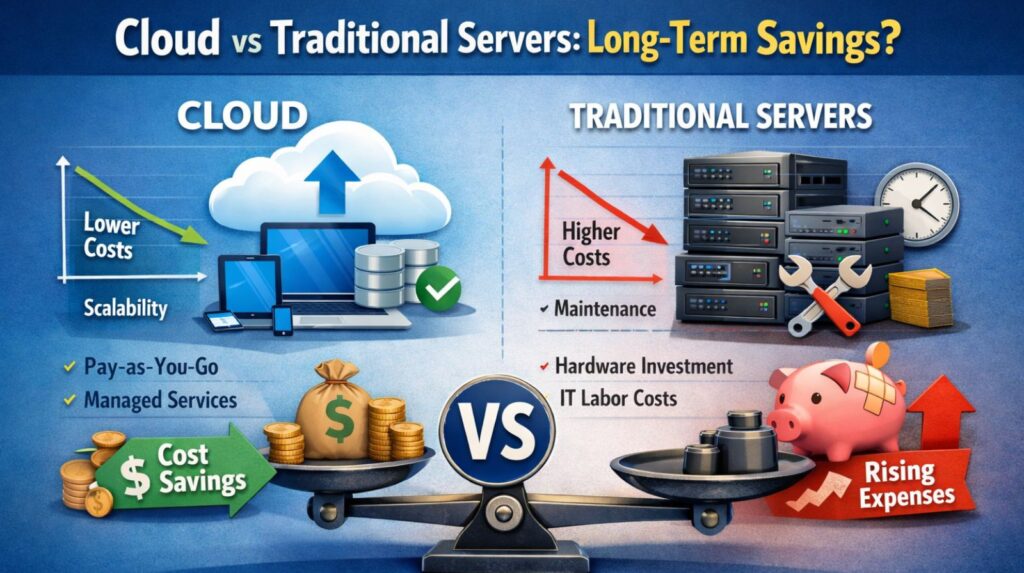
Traditional servers require significant capital expenditure. A mid-sized business might spend $50,000 to $500,000 or more on initial hardware, networking equipment, racks, cooling systems, and facility upgrades. That’s before a single line of code runs.
Cloud servers, on the other hand, have near-zero upfront costs. You simply create an account, choose a configuration, and start spinning up virtual machines within minutes. This makes the cloud dramatically more accessible for businesses of all sizes.
Ongoing and Operational Costs
With traditional servers, server maintenance costs pile up over time: electricity bills, hardware replacement cycles (typically every 3–5 years), IT staff salaries, software licensing, and security audits. These costs are ongoing and often underestimated.
Cloud pricing models (compute hours, data transfer, storage tiers) can also add up, especially at scale. However, with proper architecture and cost monitoring tools, cloud spending can be optimized continuously.
The 5-Year Total Cost of Ownership (TCO)
Studies consistently show that for small to mid-sized workloads, cloud vs on-premise infrastructure TCO can be comparable over five years — but the cloud wins significantly when you factor in hidden traditional costs: hardware refresh cycles, facilities management, redundancy infrastructure, and IT headcount.
For large enterprises with stable, predictable workloads, on-premise may be more cost-effective long-term once the initial investment is amortized. But for dynamic, growing businesses, cloud almost always delivers better financial flexibility.
Long-Term ROI: Does the Cloud Really Pay Off?
Cloud ROI is one of the most debated metrics in IT finance. Here’s the reality in 2026: cloud ROI improves significantly when you account for:
• Reduced time-to-market (faster deployment = faster revenue)
• Eliminated hardware lifecycle costs (no 3-year refresh cycles)
• Lower IT staff requirements (no 24/7 data center management)
• Pay-as-you-grow model that matches spending to actual business growth
• Built-in disaster recovery that would cost hundreds of thousands on-prem
Gartner and IDC research consistently shows that businesses migrating to cloud platforms see 15–40% reduction in overall IT operational costs within two years, with the largest gains in staff productivity and infrastructure agility.
Scalability: The Cloud’s Biggest Advantage
Cloud scalability is where traditional servers simply cannot compete. Whether you experience a sudden traffic spike, a seasonal surge, or rapid business growth, cloud platforms let you scale resources up or down in minutes — automatically if you configure it right.
Traditional infrastructure requires purchasing additional hardware months in advance, which means you’re either over-provisioned (wasting money) or under-provisioned (risking downtime). In 2026, where markets move fast and user expectations are even faster, this inflexibility is a serious business risk.
Cloud auto-scaling means you pay only for peak capacity when you need it — not year-round. For e-commerce businesses running Black Friday promotions or SaaS platforms experiencing viral growth, this elasticity is worth its weight in gold.
Server Maintenance Costs: Who Manages What?
One of the most underestimated advantages of cloud is the dramatic reduction in server maintenance costs. When you host on traditional servers, your team is responsible for:
• Hardware installation, monitoring, and replacement
• OS patching and software updates
• Network security, firewall management, and intrusion detection
• Physical security, cooling, and power redundancy
• Disaster recovery planning and backup infrastructure
With cloud, the provider handles the physical infrastructure layer. Depending on the service model (IaaS, PaaS, or SaaS), you may also offload OS management, middleware, and runtime environments. This frees your IT team to focus on innovation rather than infrastructure babysitting.
Security Considerations: Cloud vs On-Premise
Security is the most common objection to cloud adoption — and it deserves a nuanced answer. In 2026, major cloud providers invest billions annually in security infrastructure, compliance certifications (ISO 27001, SOC 2, HIPAA, GDPR), and threat intelligence that most individual businesses simply cannot replicate on-premise.
However, cloud introduces a shared responsibility model. While AWS or Azure secures the underlying infrastructure, you are responsible for securing what you put on it: access controls, encryption, application security, and data classification.
Traditional servers give you full control over security architecture — critical for highly regulated industries like finance, defense, or healthcare where data sovereignty or compliance mandates make on-prem the preferred or legally required choice.
In most cases, a well-configured cloud environment is as secure or more secure than a typical on-prem setup. The risk isn’t the cloud itself — it’s misconfiguration by the end user.