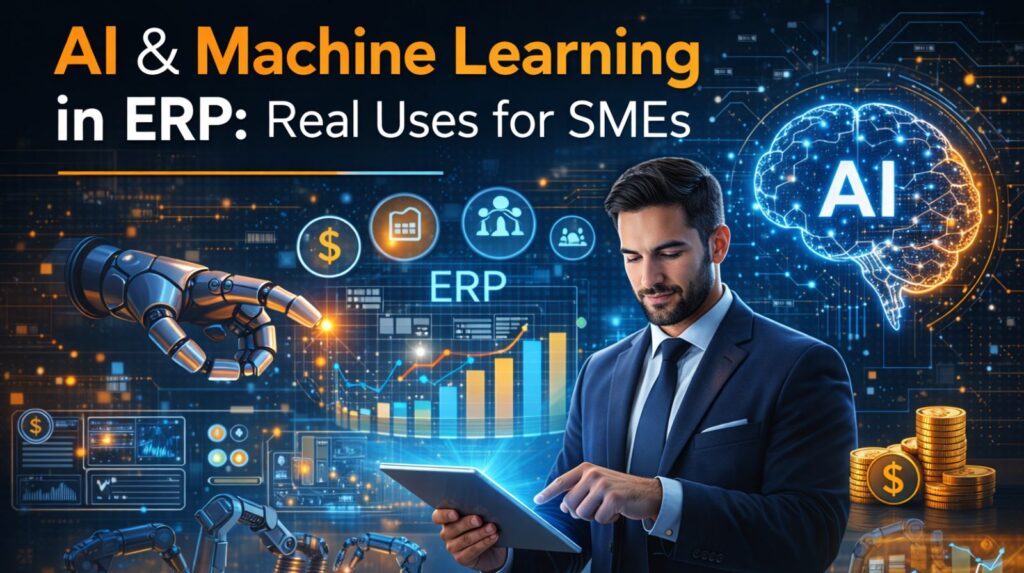
For decades, Enterprise Resource Planning (ERP) systems were the exclusive domain of large corporations with deep pockets and dedicated IT departments. Small and medium-sized enterprises (SMEs) simply couldn’t justify the cost or complexity. That’s changing fast. Thanks to artificial intelligence (AI) and machine learning (ML), modern ERP platforms are becoming smarter, more affordable, and surprisingly accessible to growing businesses.
Today’s AI-powered ERP systems do more than manage databases. They learn from data, spot patterns humans would miss, automate repetitive processes, and generate insights that help business leaders make faster, better-informed decisions. For SMEs navigating tight margins and fierce competition, this isn’t just a technological upgrade — it’s a competitive lifeline.
At its core, an ERP system integrates core business processes — finance, HR, supply chain, inventory, sales, and customer management — into a single unified platform. Traditional ERP systems are essentially sophisticated databases: structured, reliable, but reactive. They store and report what has already happened.
AI and machine learning change that equation entirely. An AI-powered ERP system doesn’t just record data — it analyzes it continuously, identifies trends, and begins making recommendations (or even autonomous decisions) based on what the data suggests. Machine learning algorithms improve over time, meaning the system gets smarter the more data it processes.
In Practice: A manufacturer using an AI-enhanced ERP might receive an automated alert that a specific component’s lead time is trending upward — before it causes a production delay — with a suggested alternative supplier already attached.
1. Inventory Management: Smarter Stock, Less Waste
Inventory mismanagement is one of the most costly challenges SMEs face. Overstock ties up capital; understock loses customers. AI-driven ERP systems tackle this with predictive inventory management, using historical sales data, seasonal trends, and external market signals to forecast demand with high accuracy.
Consider a small electronics retailer. AI & Machine Learning in ERP, the system might analyse three years of sales data alongside local event calendars and macroeconomic indicators to predict a surge in demand before the holiday season — automatically triggering purchase orders at optimal quantities, at optimal times. The result? Less dead stock, fewer emergency orders, and healthier cash flow.
• Automatic reorder triggers based on real-time consumption rates
• Demand forecasting that accounts for seasonality and external signals
• Waste reduction through expiry and shelf-life analytics (especially critical in food and pharma industries)
2. Financial Operations: From Bookkeeping to Business Intelligence
AI transforms the finance module from a record-keeper into a strategic advisor. Automated invoice processing, anomaly detection in expenses, and real-time cash flow forecasting give SME finance teams capabilities that were previously only available to enterprises with dedicated financial analysts.
A boutique logistics firm, for example, can deploy AI and Machine Learning in ERP to flag unusual expense patterns that may indicate billing errors or fraud — catching discrepancies that manual review would likely miss. Meanwhile, ML-powered cash flow forecasting gives the CFO a 90-day liquidity outlook updated daily, enabling smarter decisions about when to invest, when to borrow, and when to hold.
• Automated accounts payable and receivable processing
• Real-time anomaly detection to flag fraud or data errors
• Predictive cash flow and revenue forecasting
• Automated tax compliance and regulatory reporting
3. Supply Chain Optimisation: Resilience Through Intelligence
The post-pandemic era exposed the fragility of global supply chains. For SMEs without enterprise-level procurement teams, disruptions can be existential. AI-powered ERP systems provide a layer of supply chain intelligence that helps smaller businesses anticipate, adapt, and act.
Machine learning models continuously assess supplier performance data, lead time trends, geopolitical risk signals, and logistics bottlenecks. A small apparel company might use this capability to automatically re-route shipments when a preferred carrier’s on-time delivery rate drops below a threshold — or to identify a secondary supplier in a different region before their primary one faces disruption.
Real-World Example: A mid-sized food distributor using an AI-integrated ERP reduced supplier-related delays by 34% in one year by implementing automated supplier scorecards and ML-driven lead time predictions that triggered early reorders during at-risk windows.
4. Workflow Automation: Eliminating the Administrative Burden
One of the most immediate and tangible wins AI delivers to SMEs is the automation of repetitive, rule-based tasks. Purchase order approvals, invoice matching, employee onboarding workflows, and compliance checklists — all can be automated through intelligent ERP systems equipped with robotic process automation (RPA) and AI decision engines.
A regional HR consultancy, for instance, might automate its end-of-month payroll reconciliation entirely. The AI layer within the ERP cross-references timesheets, expense submissions, and benefit deductions, flags discrepancies for human review, and processes clean records automatically — reducing what was once a two-day task to under four hours.
5. Customer Insights: Knowing Your Customer Before They Do
CRM capabilities embedded within AI-powered ERP platforms give SMEs the ability to analyse customer behaviour at a granular level. Purchase history, service interactions, payment patterns, and web activity feed into ML models that generate customer lifetime value scores, churn risk alerts, and personalised product recommendations.
A small B2B SaaS company can use these insights to identify which clients are at risk of churning — based on declining usage metrics and slower payment cycles — and trigger automated outreach campaigns or escalate to an account manager before the relationship deteriorates. This kind of proactive engagement was previously the preserve of enterprise CRM teams; now it’s available to any SME running an intelligent ERP.
Key Benefits for Growing Businesses
• Faster, data-driven decision-making at every level of the organisation
• Significant reduction in manual data entry and human error
• Improved operational efficiency and resource allocation
• Enhanced financial visibility and forecasting accuracy
• Greater supply chain resilience and supplier agility
• Scalable automation that grows alongside the business
• Better customer retention through personalised, data-informed engagement
Despite the compelling benefits, the path to AI-driven ERP adoption isn’t without obstacles. SMEs considering this transition should be aware of the following challenges:
Data Quality and Readiness
AI models are only as good as the data they’re trained on. Many SMEs have fragmented, inconsistent, or incomplete historical data — which can undermine the accuracy of AI-generated insights. A data audit and clean-up exercise is typically a necessary first step before AI features can deliver reliable value.
While SaaS-based ERP platforms have dramatically reduced upfront costs, implementation still requires time, internal resources, and often external consultancy support. SMEs must budget realistically for change management, staff training, and the inevitable productivity dip during the transition period.
Skills and Internal Expertise
Getting the most from an AI-powered ERP requires staff who can interpret AI-generated insights critically, configure automation rules sensibly, and validate anomalies rather than blindly accepting algorithmic outputs. This demands upskilling investment, which many SMEs underestimate.
Vendor Selection and Lock-In
The ERP landscape is crowded, and AI capabilities vary enormously between vendors. SMEs must evaluate platforms carefully — assessing not just current feature sets but the vendor’s AI development roadmap, data portability, integration flexibility, and long-term pricing trajectory.
The trajectory is clear: AI will become the default operating layer of all ERP systems, not a premium add-on. Several trends will shape what this looks like for SMEs over the next three to five years:
• Conversational AI interfaces will allow non-technical users to query their ERP data in plain language — asking “Why did our margin drop in Q3?” and receiving an AI-synthesised answer with supporting data.
• Autonomous agents within ERP platforms will handle increasingly complex decisions, such as multi-step supplier negotiations or dynamic pricing adjustments, without human initiation.
• Predictive analytics will become more precise as AI models are trained on richer industry-specific datasets, improving forecasting accuracy for niche sectors.
• Embedded generative AI will assist with contract drafting, financial narrative generation, and compliance documentation — reducing dependence on external professional services.
• Greater interoperability between AI-powered ERP platforms and IoT sensors, e-commerce platforms, and logistics networks will enable truly end-to-end intelligence.
For SMEs, the message is straightforward: early adopters will build data assets, automated capabilities, and institutional knowledge that become significant competitive moats. Waiting until AI-powered ERP is ubiquitous means playing catch-up against competitors who have already refined their systems over years of real-world learning.
AI & Machine Learning in ERP are no longer futuristic concepts reserved for Silicon Valley giants. They are practical, deployable, and increasingly essential tools for SMEs that want to operate with the efficiency and intelligence of much larger organisations. Whether it’s predicting inventory needs three months out, automating financial reconciliation, or identifying which customers are most likely to churn, AI-powered ERP systems bring enterprise-grade intelligence to businesses of every size.
The question for SME leaders is no longer whether to invest in intelligent ERP technology — it’s how soon, and which platform will best position their business to capitalise on the data they’re already generating every day.
4.9 google Reviews
Lorem ipsum dolor sit amet, consectetur adipiscing elit. Ut elit tellus, luctus nec ullamcorper mattis, pulvinar dapibus leo.