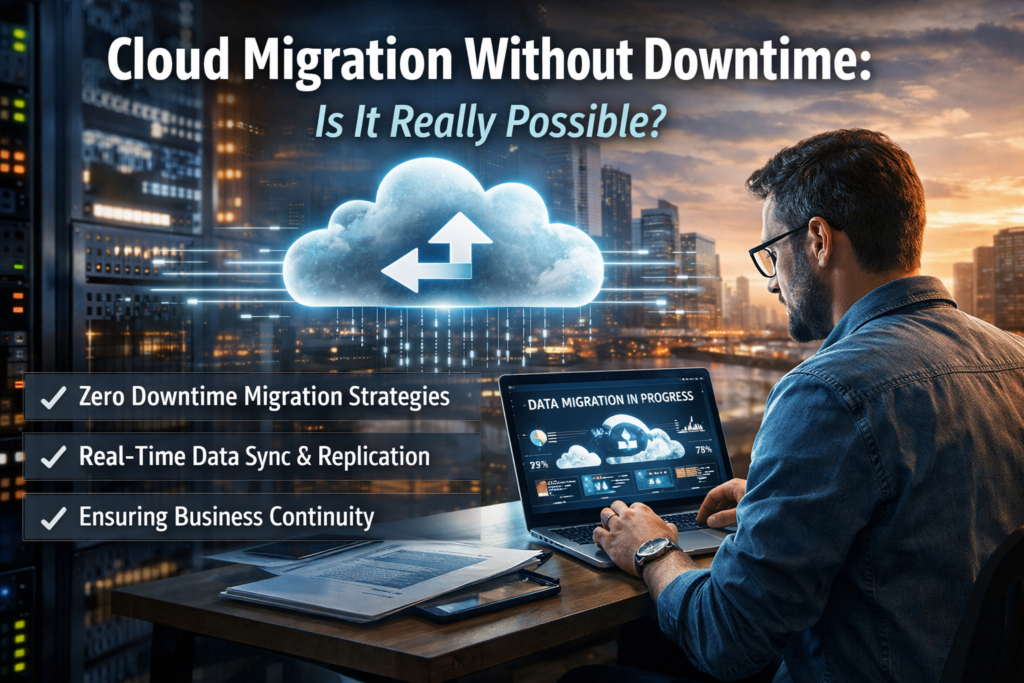
In today’s always-on digital economy, businesses face a critical challenge: how to execute a cloud migration without downtime while maintaining seamless operations. As organizations scale and replatform their infrastructure, the question isn’t whether to move to the cloud, but how to do it without disrupting business continuity.
Zero-downtime cloud migration refers to the process of transferring applications, data, and workloads from on-premises infrastructure or legacy systems to cloud environments without causing service interruptions. While it may sound like a technical impossibility, modern migration strategies and tools have made cloud migration without downtime not just possible, but increasingly common.
The reality is that achieving truly zero-downtime migration requires careful planning, the right architecture, and proven migration methodologies. But yes—it is absolutely possible when executed correctly.
Business Continuity and Revenue Protection
For many organizations, even minutes of downtime can result in significant financial losses. E-commerce platforms, SaaS providers, and financial institutions cannot afford service interruptions. A downtime-free cloud migration ensures that:
– Customer-facing applications remain accessible 24/7
– Revenue streams continue uninterrupted
– User experience remains consistent throughout the transition
– Brand reputation stays protected
Competitive Advantage
In competitive markets, availability is a differentiator. Companies that can execute seamless cloud migration without impacting users gain a significant edge over competitors who struggle with migration-related outages.
1. Blue-Green Deployment Strategy
Blue-green deployment is one of the most effective techniques for achieving zero-downtime cloud migration. This approach involves:
– Maintaining your current production environment (blue)
– Creating an identical cloud environment (green)
– Gradually routing traffic to the new environment
– Rolling back instantly if issues arise
This migration pattern ensures that your legacy infrastructure remains operational while the cloud environment is tested and validated. Once confidence is established, traffic switches over seamlessly.
2. Database Replication and Synchronization
Database migration often presents the biggest challenge in cloud migration without downtime. Advanced replication techniques enable:
– Real-time data synchronization between on-premises and cloud databases
– Minimal lag during the transition period
– Ability to maintain data consistency across environments
– Validation of data integrity before final cutover
Technologies like AWS Database Migration Service, Azure Database Migration Service, and Google Cloud Database Migration Service support continuous replication, making zero-downtime database migration achievable.
3. Canary Releases and Gradual Traffic Shifting
Rather than switching all traffic at once, canary releases allow you to:
– Route a small percentage of traffic to the cloud environment
– Monitor performance and identify issues early
– Gradually increase traffic to the cloud
– Maintain fallback capabilities throughout the process
This incremental approach to cloud migration without downtime reduces risk and enables rapid response to unexpected challenges.
4. Load Balancer Configuration
Intelligent load balancers serve as traffic directors during migration, enabling:
– Dynamic routing between on-premises and cloud environments
– Health checks to ensure traffic goes only to healthy endpoints
– Weighted distribution for controlled migration
– Instant failover capabilities
Modern application load balancers make seamless cloud migration possible by managing the complexity of multi-environment traffic distribution.
Containerization and Kubernetes
Container technologies have revolutionized cloud migration without downtime by enabling:
– Application portability across environments
– Consistent deployment patterns
– Rolling updates without service interruption
– Easy rollback mechanisms
Kubernetes orchestration platforms provide sophisticated deployment strategies that support zero-downtime migration at scale.
Infrastructure as Code (IaC)
Tools like Terraform, CloudFormation, and ARM templates enable:
– Reproducible infrastructure deployment
– Version-controlled infrastructure changes
– Automated environment provisioning
– Consistent configuration across environments
IaC is fundamental to successful downtime-free cloud migration because it eliminates manual configuration errors and ensures environment parity.
API Gateways and Service Mesh
Modern API gateways and service mesh technologies provide:
– Intelligent traffic routing capabilities
– Circuit breaker patterns for fault tolerance
– A/B testing capabilities during migration
– Observability throughout the migration process
These technologies are essential infrastructure components for cloud migration without downtime in microservices architectures.
Challenge 1: State Management
Solution: Implement distributed session management using Redis or similar technologies that can span on-premises and cloud environments. This ensures user sessions persist during the migration.
Challenge 2: DNS Propagation Delays
Solution: Reduce DNS TTL values before migration and use global traffic management solutions that enable faster cutover with minimal propagation delays.
Challenge 3: Data Consistency
Solution: Leverage change data capture (CDC) technologies and implement eventual consistency patterns where appropriate. Strong consistency requirements may necessitate brief maintenance windows, but these can be minimized to seconds rather than hours.
Challenge 4: Legacy Application Constraints
Solution: Not all applications support zero-downtime migration. For legacy applications, consider replatforming or refactoring critical components to cloud-native architectures before migration.
Phase 1: Assessment and Planning
– Conduct thorough application dependency mapping
– Identify migration complexity and risks
– Select appropriate migration strategy for each workload
– Establish clear success metrics and rollback procedures
Phase 2: Environment Preparation
– Provision cloud infrastructure using IaC
– Establish network connectivity between environments
– Configure security controls and access policies
– Set up monitoring and observability tools
Phase 3: Data Migration
– Implement database replication mechanisms
– Synchronize data continuously
– Validate data integrity and consistency
– Test failover and failback procedures
Phase 4: Application Migration
– Deploy applications to cloud environment
– Execute comprehensive testing
– Configure load balancers for traffic distribution
– Begin gradual traffic shifting
Phase 5: Cutover and Validation
– Monitor application performance closely
– Validate business functionality
– Confirm data synchronization
– Decommission legacy infrastructure after stability period
Organizations that successfully achieve cloud migration without downtime typically share these characteristics:
– Executive buy-in for adequate time and resource investment
– Cross-functional collaboration between development, operations, and business teams
– Automation-first mindset that minimizes manual intervention
– Comprehensive testing including performance, security, and disaster recovery scenarios
– Clear communication plans that keep stakeholders informed throughout the process
Key performance indicators for zero-downtime cloud migration include:
– Application availability percentage during migration
– Performance metrics comparison (pre and post-migration)
– Data loss or corruption incidents
– Rollback frequency and duration
– User-reported issues during transition
Cloud migration without downtime is not only possible—it’s becoming the expected standard for modern enterprises. As organizations continue scaling their operations and replatforming legacy systems, the ability to migrate seamlessly without disrupting business operations is critical.
Success requires the right combination of strategy, technology, and expertise. While zero-downtime migration demands more planning and sophisticated tooling than traditional “big bang” approaches, the benefits far outweigh the investment. Organizations that master downtime-free cloud migration position themselves for greater agility, scalability, and competitive advantage in an increasingly cloud-first world.
The question is no longer whether cloud migration without downtime is possible, but whether your organization is prepared to execute it successfully. With proper planning, modern tools, and proven methodologies, your next cloud migration can be invisible to your users—which is exactly how it should be.

4.9 google Reviews
Lorem ipsum dolor sit amet, consectetur adipiscing elit. Ut elit tellus, luctus nec ullamcorper mattis, pulvinar dapibus leo.