In today’s rapidly evolving digital landscape, growing businesses face a critical challenge: how to scale their
operations efficiently while keeping costs under control. The answer increasingly lies in the powerful
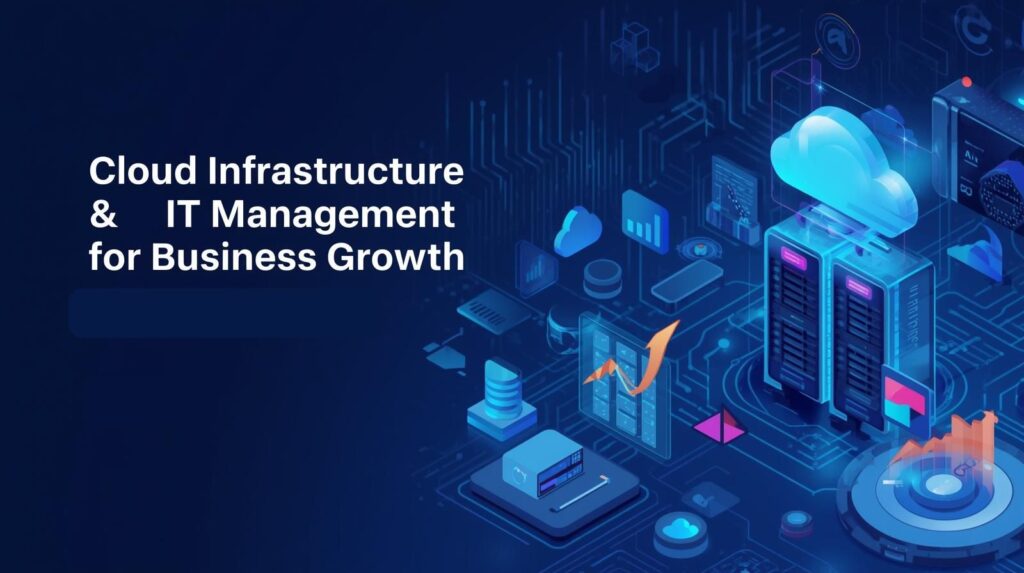
combination of cloud infrastructure and AI-driven IT management. This technological synergy is transforming
how companies operate, compete, and grow in the modern marketplace.
Cloud infrastructure refers to the virtualized computing resources delivered over the internet, including servers,
storage, databases, networking, and software. Unlike traditional on-premises IT systems that require significant
capital investment and physical space, cloud infrastructure operates on a pay-as-you-go model that aligns
perfectly with the needs of growing businesses.
For companies experiencing rapid growth, cloud infrastructure eliminates the need to predict future capacity
requirements years in advance. Instead of purchasing expensive hardware that might sit idle or become
obsolete, businesses can scale their computing resources up or down based on real-time demand. This flexibility
is invaluable for companies navigating unpredictable market conditions or seasonal fluctuations.
Traditional IT infrastructure requires substantial upfront investment in servers, networking equipment, cooling systems, and physical space. Growing businesses often struggle with this financial burden, especially when trying to balance technology investments with other critical business needs.
Cloud infrastructure eliminates these capital expenses, converting them into predictable monthly operational costs. Combined with AI-driven management that optimizes resource usage and reduces waste, businesses can achieve significant cost savings. Studies show companies can reduce IT infrastructure costs by 30-50% through cloud migration and intelligent automation.
Business growth is rarely linear. Companies experience spikes in demand during product launches, seasonal
peaks, or viral marketing campaigns. Traditional IT infrastructure can’t easily accommodate these fluctuations, forcing businesses to either over-provision resources or risk performance issues during critical periods. Cloud infrastructure with AI-driven management automatically scales resources to meet demand. Machine learning algorithms analyze usage patterns and predict future needs, ensuring optimal performance without manual intervention. This elasticity allows growing businesses to seize opportunities without worrying about infrastructure limitations.

Cybersecurity threats evolve constantly, and growing businesses often lack the resources to maintain dedicated security teams. Cloud providers invest billions in security infrastructure and employ world-class security experts, providing protection that would be prohibitively expensive for individual companies.
AI-driven security systems enhance this protection by continuously monitoring for anomalies, identifying
potential threats in real-time, and responding to incidents faster than human teams could. These systems learn from every attempted attack, becoming more effective over time and helping businesses maintain compliance with industry regulations.
In competitive markets, speed matters. Companies that can quickly develop, test, and launch new products or features gain significant advantages over slower competitors. Cloud infrastructure provides instant access to
cutting-edge technologies like containerization, serverless computing, and development platforms that
accelerate innovation.
AI-driven IT management further accelerates development by automating testing, identifying bugs, optimizing
code performance, and managing deployment pipelines. Development teams can focus on creating value rather
than managing infrastructure, reducing time-to-market by weeks or even months.
Traditional disaster recovery plans require duplicate infrastructure, complex backup procedures, and regular
testing. Many growing businesses lack the resources to implement comprehensive disaster recovery, leaving
them vulnerable to data loss or extended downtime.
Cloud infrastructure providers offer built-in redundancy across multiple geographic locations, ensuring business
continuity even during major disruptions. AI-driven systems automatically backup data, monitor system health,
and can initiate failover procedures within seconds of detecting issues. This level of protection would cost
growing businesses millions to replicate on-premises.
AI-driven IT management doesn’t just maintain systems; it generates valuable insights about business
operations. These systems analyze performance metrics, user behavior, resource utilization, and countless other
data points to identify optimization opportunities.
Growing businesses can leverage these insights to make informed decisions about capacity planning, feature
development, user experience improvements, and market expansion. The ability to base strategic decisions on
comprehensive data analysis rather than intuition provides a substantial competitive advantage.
Cloud providers continuously invest in emerging technologies like artificial intelligence, machine learning,
Internet of Things platforms, and advanced analytics tools. Growing businesses gain immediate access to these
enterprise-grade capabilities without massive investments in specialized hardware or expertise.
This democratization of technology allows smaller companies to compete with larger enterprises on a more
level playing field. A startup can leverage the same AI and machine learning capabilities as Fortune 500
companies, enabling innovation that would have been impossible just a few years ago.
Successfully leveraging cloud infrastructure and AI-driven IT management requires thoughtful planning and
execution. Growing businesses should start by assessing their current IT landscape, identifying bottlenecks, and prioritizing applications for cloud migration.
Begin with non-critical applications to gain experience and build confidence before moving mission-critical
systems. Invest in training your team on cloud technologies and AI tools to maximize their effectiveness.
Consider partnering with managed service providers who specialize in cloud migration and AI implementation if internal expertise is limited.
Establish clear metrics to measure success, including cost savings, performance improvements, security
incidents, and time-to-market for new features. Regularly review and optimize your cloud architecture and AI configurations to ensure you’re maximizing value from these investments.
The convergence of cloud infrastructure and AI-driven IT management represents a fundamental shift in how
businesses operate. Growing companies that embrace these technologies position themselves for sustainable
competitive advantage, operational efficiency, and accelerated growth.
As AI capabilities continue advancing and cloud infrastructure becomes more sophisticated, the gap between
early adopters and laggards will only widen. The businesses thriving in tomorrow’s marketplace will be those
that recognized cloud and AI not as optional upgrades, but as essential foundations for modern business success.
The question for growing businesses isn’t whether to adopt cloud infrastructure and AI-driven IT management,
but how quickly they can implement these technologies to stay ahead of the competition.
While cloud infrastructure provides the foundation, AI-driven IT management is revolutionizing how businesses
optimize and maintain their technology systems. Artificial intelligence and machine learning algorithms can
monitor vast amounts of data, identify patterns, predict issues before they occur, and automate routine tasks that
once consumed countless hours of IT staff time.
AI-driven IT management systems can automatically detect security threats, optimize resource allocation,
predict hardware failures, and even resolve common technical issues without human intervention. This
proactive approach transforms IT from a reactive cost center into a strategic asset that drives business value.