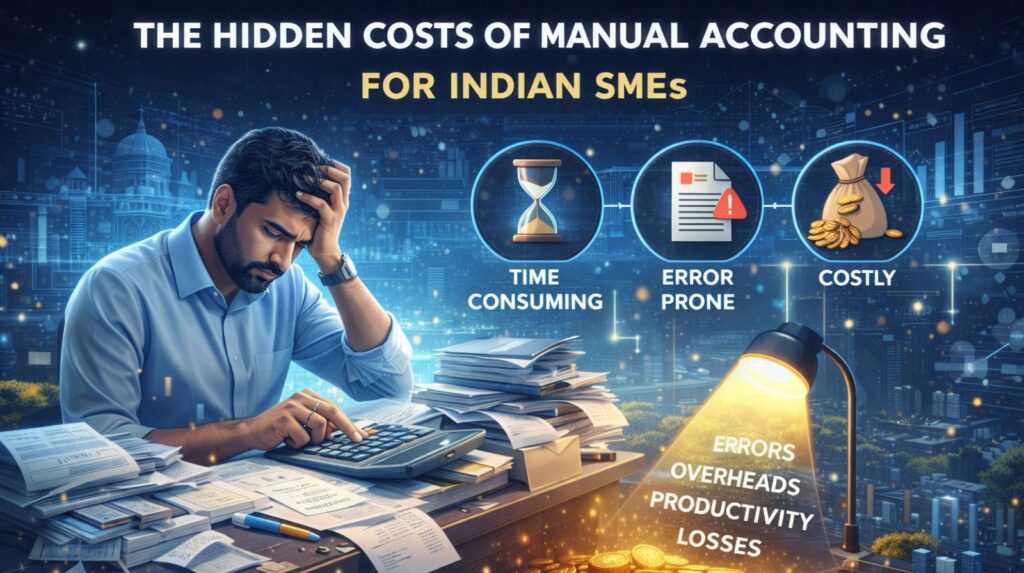
Imagine this: An Indian SME owner, Ramesh, spends countless hours every week entering data into spreadsheets, fixing errors, and reconciling mismatched records. As deadlines loom and stress mounts, he realizes that his manual accounting processes are not just inefficient—they’re costing him dearly. plague many businesses, leading to hidden losses that can significantly impact their bottom line.
In this blog, we will explore the invisible costs associated with manual accounting, quantify their impact, and discuss how automation can transform the accounting landscape for Indian SMEs.
Manual accounting often feels like a necessary evil for many SMEs. While it may seem manageable at first, the burden quickly escalates as the business grows.
Time Wasted on Repetitive Tasks
One of the most glaring issues with manual accounting is the time wasted on repetitive tasks. Business owners and accountants often find themselves spending hours on data entry, invoice generation, and reconciliation. According to recent insights, SMEs can waste up to 30% of their work hours on these repetitive tasks, time that could be better spent on strategic initiatives.
Human Errors Leading to Financial Mismatches
Human errors are another significant drawback of manual accounting. A simple typo can lead to financial mismatches, causing discrepancies that require time-consuming investigations to resolve. Many businesses report that these errors can lead to costs ranging from minor adjustments to significant financial losses, impacting cash flow and profitability.
Missed GST Deadlines and Penalties
In India, compliance with GST regulations is mandatory, and the consequences of missed deadlines can be severe. Manual accounting increases the risk of errors in GST filings, leading to penalties that can amount to thousands of rupees. In 2026, it is estimated that SMEs collectively face compliance risks that could exceed ₹500 crores due to manual accounting shortcomings.
Lack of Real-Time Financial Visibility
Another critical issue is the lack of real-time financial visibility. Manual processes often result in outdated financial information, making it difficult for business owners to make informed decisions. Without accurate and timely data, SMEs may struggle to identify trends, manage cash flow, and respond to market changes effectively.
Poor Decision-Making Due to Outdated Data
Outdated data can lead to poor decision-making, which can be detrimental to an SME’s growth. In a fast-paced business environment, relying on stale information can result in missed opportunities and strategic missteps. Many businesses report that they have lost competitive advantages due to delays in accessing crucial financial insights.
The hidden costs of manual accounting go beyond mere inefficiencies. They encompass a range of financial implications that can accumulate over time.
Time Losses
The time spent on manual accounting tasks can add up quickly. For instance, if an accountant spends an average of 10 hours per week on data entry and reconciliation, that equates to 520 hours annually. At an average hourly rate of ₹500, this translates to a staggering ₹2.6 lakhs lost each year just on time alone.
Financial Mismatches
Human errors can lead to significant financial mismatches. For example, a single error in invoicing can result in a loss of revenue or overpayment to suppliers. In 2026, studies show that SMEs could face losses of up to ₹1 lakh annually due to these mismatches, affecting their overall financial health.
Compliance Risks
The risks associated with missed GST deadlines and penalties can be crippling. An SME that fails to file GST returns on time may incur penalties of up to ₹10,000 per instance. For businesses that frequently miss deadlines, these costs can escalate quickly, resulting in financial strain.
Decision-Making Challenges
The lack of real-time financial visibility can lead to poor decision-making, costing SMEs opportunities for growth. In 2026, research indicates that businesses lacking timely financial insights may lose out on potential revenue streams, amounting to losses of up to ₹5 lakhs annually.
To understand the true cost of manual accounting, it’s essential to quantify these inefficiencies.
When combined, these hidden costs can total over ₹8 lakhs annually for an SME, making manual accounting not just inefficient, but also prohibitively expensive.
Recognizing the pressing need to address these challenges, many Indian SMEs are beginning to embrace automation. The shift to automated accounting processes can significantly alleviate the burdens of manual accounting.
Benefits of Accounting Automation
Automation offers a range of benefits that can transform the accounting landscape for SMEs.
Case Study: An Indian SME’s Transition
Consider the case of a small manufacturing SME in India that transitioned from manual accounting to an automated system. Initially, the company struggled with time-consuming data entry, frequent errors, and missed GST deadlines. After implementing an automated accounting solution integrated with Tally, the SME saw remarkable improvements.
Within six months, the company reduced its accounting time by 60%, allowing the finance team to focus on strategic planning. The accuracy of financial records improved significantly, with errors dropping by 80%. Additionally, the SME gained real-time financial clarity, enabling better decision-making and ultimately increasing profitability.
In today’s fast-moving business environment, sticking to manual accounting isn’t saving money—it’s silently draining it. The hidden costs of manual accounting can accumulate quickly, impacting an SME’s financial health and growth potential.
Automation is no longer a luxury; it’s a necessity for growth. By embracing modern tools and technologies, Indian SMEs can eliminate manual work, reduce errors, and gain real-time financial insights that empower better decision-making. The transition to automation is not just an operational upgrade; it’s a strategic imperative for survival and success in the competitive landscape of 2026.

4.9 google Reviews
Lorem ipsum dolor sit amet, consectetur adipiscing elit. Ut elit tellus, luctus nec ullamcorper mattis, pulvinar dapibus leo.