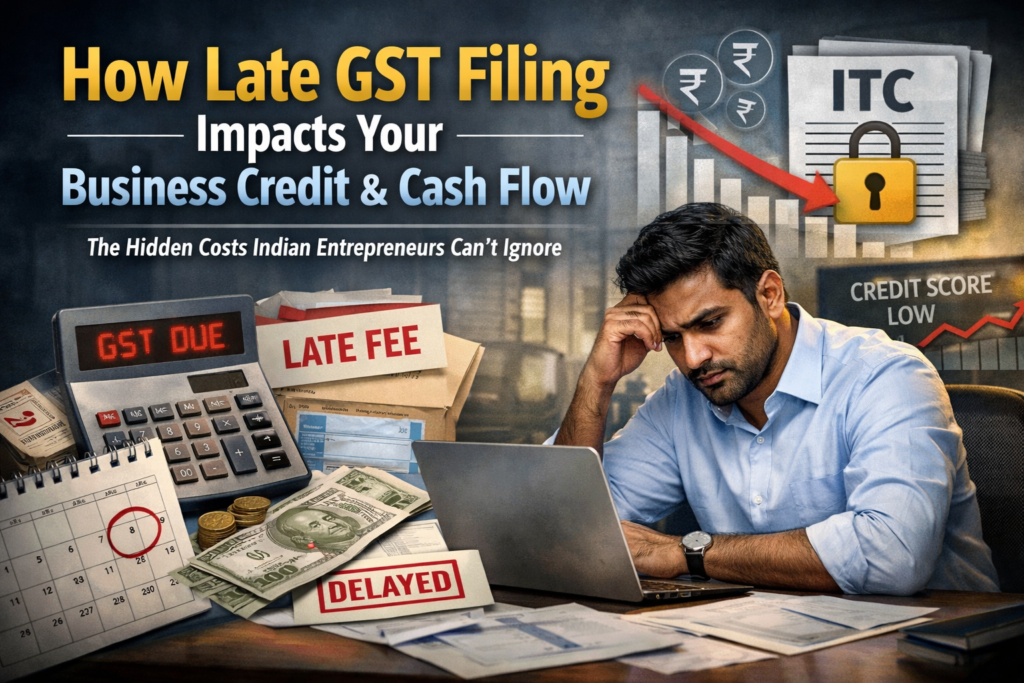
Every Indian entrepreneur knows the feeling — another deadline slipped through the cracks, another month where the GST portal sat untouched until panic set in. It feels minor in the moment. A few days late. No big deal, right? Late GST filing is one of the most quietly destructive habits a business can develop. It doesn’t announce itself with a dramatic warning. Instead, it chips away at your business credit, locks up your cash flow, and compounds penalties day by day — until a problem that could have cost you nothing turns into a five-figure financial hit.
And here’s the part most entrepreneurs miss entirely: AI workflow automation is already reshaping how smart businesses solve this exact problem. But before we talk solutions, you need to understand exactly how deep the damage goes.
Under Section 47 of the CGST Act, the penalties for late filing are automatic. There is no grace period, no warning letter, and no negotiation window. The moment your due date passes, the meter starts running.
For GSTR-1 and GSTR-3B — the two returns every registered business must file — a late fee of ₹50 per day kicks in immediately. That breaks down to ₹25 under CGST and ₹25 under SGST, and it compounds until you file or hit the cap of ₹5,000 per return. If your return is a nil return (zero transactions), the fee drops to ₹20 per day, but it still applies.
On top of late fees, if you have any outstanding GST tax liability, you are liable to pay interest at 18% per annum on the unpaid amount, calculated from the day after the due date to the date of actual payment. This interest is calculated manually and must be self-declared — the GST portal does not auto-populate it. Many business owners don’t even realise this charge is accumulating until they receive a notice.
Here’s a quick example to make it concrete. Suppose you owe ₹1,00,000 in GST and you delay payment by 60 days. The interest alone comes to approximately ₹2,959. Add 60 days of late fees at ₹50 per day, and you’re looking at ₹3,000 more. A single missed deadline just cost you nearly ₹6,000 — before any further consequences kick in.
Late fees and interest are painful, but they are capped and calculable. The real damage to your cash flow comes from Input Tax Credit (ITC) blockage — and most entrepreneurs don’t fully grasp its impact.
Under GST law, you can only claim ITC on purchases if your supplier has correctly filed their GSTR-1 and if the invoice appears in your auto-generated GSTR-2B. If your own filings are delayed or incomplete, your downstream buyers lose the ability to claim credit on invoices you’ve raised. And if your supplier hasn’t filed, you cannot claim ITC on what you’ve already paid.
This creates a domino effect across your supply chain. Your working capital gets tied up in taxes you’ve already paid but cannot recover. For SMEs and startups operating on tight margins, this isn’t a minor inconvenience — it is a cash flow crisis.
There’s a harder consequence too. If you fail to file GST returns for three or more consecutive months, the GST portal will block your ability to file GSTR-1 for subsequent months entirely. And if the non-compliance persists, your GST registration can be suspended or even cancelled — effectively shutting down your ability to do business with any registered entity in India.
GST compliance isn’t just about tax. It has become a de facto measure of business credibility in India’s commercial ecosystem.
Banks and NBFCs now routinely pull your late GST filing history when evaluating loan applications. A spotty compliance record — missed filings, pending notices, or ITC mismatches — signals financial instability. This makes it harder to secure business loans, increases your borrowing costs, and puts you at a disadvantage compared to competitors who file on time.
Suppliers and large corporates also check GST compliance before onboarding new vendors. If your filing record shows gaps, you may simply not get shortlisted. In a B2B ecosystem driven by e-invoicing and real-time data matching, your GST health score is your professional reputation.
The old approach — downloading spreadsheets, manually entering invoice data, filing at the last minute — worked when GST was new and enforcement was loose. That era is over.
In 2025, the government has tightened compliance infrastructure significantly. E-invoicing is mandatory for businesses above ₹5 crore in turnover. The Invoice Management System (IMS) allows the GST portal to track invoice acceptance and rejection in real time. Starting July 2025, output tax liability fields in GSTR-3B are auto-filled and locked directly from GSTR-1 data, meaning any errors must be corrected at the source before filing.
The GSTN is also deploying AI-based tools internally — systems like BIFA (Business Intelligence & Fraud Analytics) and ADVAIT — to detect anomalies, flag fake invoicing networks, and automatically trigger notices when filing patterns deviate from expected benchmarks. The government’s margin for error tolerance is shrinking every quarter.
Manual processes simply cannot keep up.
This is where the shift happens. AI workflow automation is no longer a luxury tool reserved for large enterprises. It is becoming the standard operating method for any business that wants to stay compliant without dedicating an entire team to it.
Here is what modern AI-powered GST tools actually do for your business:
Automated invoice matching and reconciliation. AI algorithms compare your purchase invoices with GSTR-2A and GSTR-2B in real time, flagging mismatches instantly. What once took days of manual cross-referencing now happens in minutes. This directly protects your ITC claims and keeps your cash flow healthy.
Deadline tracking and proactive alerts. AI-driven systems monitor every filing deadline — GSTR-1, GSTR-3B, GSTR-4, GSTR-9 — and send automated reminders well in advance. No more last-minute scrambles or missed due dates.
Error detection before submission. Before a return is filed, AI scans for missing fields, calculation errors, duplicate invoices, and HSN code mismatches. Catching these before filing prevents notices, penalties, and the reputational damage that comes with incorrect returns.
Predictive risk assessment. Advanced AI tools analyse your historical filing data and flag patterns that could attract audits — unusual ITC claims, vendor inconsistencies, or expense-revenue mismatches. This gives you time to correct issues before tax authorities take notice.
Seamless integration with existing tools. Platforms like TallyPrime, Zoho Books, and QuickBooks now support AI-driven GST workflows through APIs. Transactions flow automatically between your accounting software and the GST portal, eliminating manual data entry entirely.
Business owners who have adopted these tools report cutting GST compliance workload by 60 to 80 percent. More importantly, they report zero late filings — which means zero penalties, zero interest charges, and zero ITC blockage.
If you are still relying on manual processes or filing GST returns reactively, you are already behind. Here is a practical starting point:
First, audit your current filing status. Check your GSTR-2B for the last six months and identify any unreconciled invoices or pending ITC claims. This gives you a baseline.
Second, evaluate AI-powered compliance tools that integrate with your existing accounting software. Look for features like automated reconciliation, deadline alerts, and error detection. Most offer free trials, so there is no cost to testing.
Third, establish a monthly compliance rhythm. Reconciliation should not be a quarterly or annual exercise — it should happen every 30 days. AI tools make this effortless, but the habit matters.
Fourth, treat GST compliance as a business strategy, not just a tax obligation. Every filing you make on time builds your credibility with banks, suppliers, and regulators. Every penalty you avoid stays in your working capital.
Late GST filing is not a minor administrative slip. It is a compounding financial and reputational risk that affects your business credit, drains your cash flow, and blocks the Input Tax Credit your business has already earned.
AI workflow automation is the most effective and scalable solution available to Indian entrepreneurs and business owners today. It does not replace your accountant or your tax advisor — it amplifies their work, eliminates human error, and ensures your business stays ahead of an increasingly strict compliance environment.
The businesses that will thrive in India’s GST ecosystem over the next three to five years are not the ones with the biggest teams. They are the ones with the smartest systems.

4.9 google Reviews
Lorem ipsum dolor sit amet, consectetur adipiscing elit. Ut elit tellus, luctus nec ullamcorper mattis, pulvinar dapibus leo.