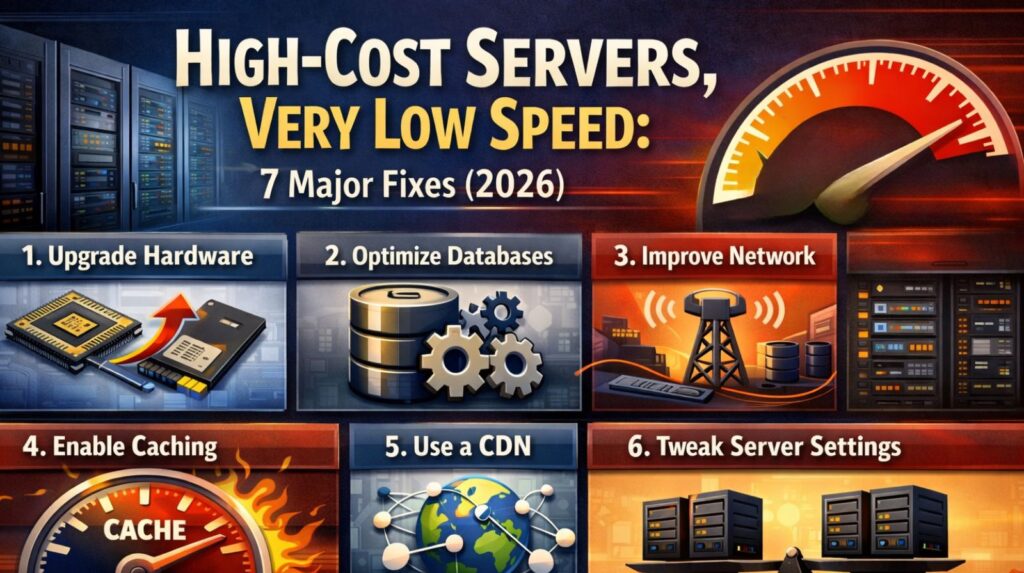
In today’s competitive business landscape, dealing with high cost server low performance issues has become a critical challenge for IT managers and business leaders. Organizations frequently find themselves investing substantial resources in server infrastructure while experiencing suboptimal returns. This comprehensive guide explores the root causes and provides actionable solutions to address these performance-cost imbalances.
The relationship between server costs and performance isn’t always linear. Many businesses face high cost server low performance scenarios due to complex infrastructure interactions and inefficient resource allocation. Understanding this correlation is crucial for optimizing your IT investments and achieving better ROI.
Key Performance Indicators
To effectively evaluate server performance against costs, consider these essential metrics:
● Response time and latency
● Resource utilization rates
● Cost per transaction
● System availability
● Throughput capacity
Poor Configuration and Setup Issues
Improper server configuration often leads to high cost server low performance problems. Regular [server monitoring tools](/server-monitoring-tools) can help identify these configuration gaps and suggest optimization opportunities.
Outdated Hardware Dependencies
Legacy hardware components frequently contribute to performance bottlenecks while consuming excessive power and maintenance resources. Upgrading strategically can significantly improve cost-efficiency ratios.
Absence of Load Balancing
Without proper load balancing, servers experience uneven resource distribution, leading to performance degradation and increased operational costs. Implementing effective load balancing solutions can help distribute workloads more efficiently.
Shared Hosting Limitations
Many organizations experiencing high cost server low performance issues are constrained by shared hosting environments. Consider [cloud migration guide](/cloud-migration-guide) options for better resource allocation and scalability.
Incorrect Cloud Plan Selection
Choosing inappropriate cloud service plans can result in overpaying for underutilized resources or suffering from performance limitations due to insufficient capacity.
Performance Monitoring Gaps
Lack of comprehensive monitoring leads to reactive rather than proactive management, increasing both costs and performance issues over time.
Resource Allocation Inefficiencies
Improper resource allocation often results in wasted capacity in some areas while creating bottlenecks in others.
Measuring Business Impact and ROI
Understanding the financial impact of server performance is crucial for business decision-making. Use our [infrastructure cost calculator](/infrastructure-cost-calculator) to evaluate your current setup.
Performance vs. Cost Comparison
| Aspect | Non-Optimized Servers | Optimized Servers |
|——–|———————|——————|
| Response Time | Variable and slow | Consistent and fast |
| Resource Usage | Inefficient | Efficient |
| Maintenance Needs | High | Reduced |
| Scalability | Limited | Flexible |
| Cost Efficiency | Poor | Improved |
Implementing strategic solutions can help address high cost server low performance challenges effectively. Follow our [server optimization checklist](/server-optimization-checklist) for systematic improvements.
Immediate Action Items
● Conduct thorough performance audits
● Optimize server configurations
● Implement automated monitoring
● Review resource allocation
● Update outdated components
Long-term Strategies
● Develop scaling plans
● Implement predictive maintenance
● Establish performance benchmarks
● Create cost optimization protocols
Preparing for future demands while maintaining optimal performance requires strategic planning and regular assessments. Consider these aspects:
Technology Evolution
● Cloud-native solutions
● Containerization opportunities
● Automation possibilities
● AI-driven optimization
Capacity Planning
● Growth projections
● Resource forecasting
● Budget allocation
● Performance targets

4.9 google Reviews
Lorem ipsum dolor sit amet, consectetur adipiscing elit. Ut elit tellus, luctus nec ullamcorper mattis, pulvinar dapibus leo.