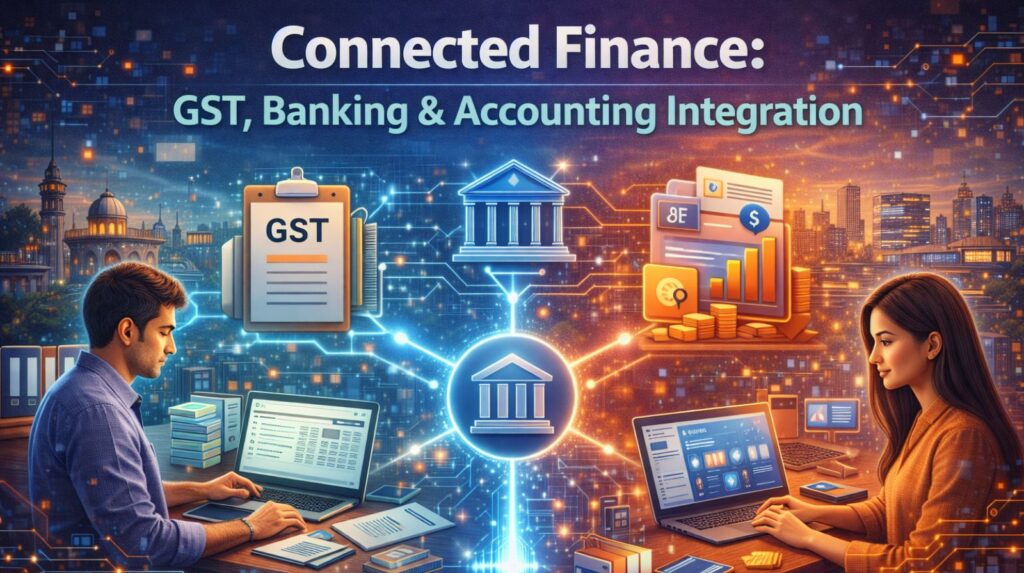
In 2026, the landscape of finance for Indian SMEs is evolving rapidly, necessitating a where GST, banking, and accounting systems are seamlessly integrated. This integration is essential for modern businesses to thrive, enabling them to streamline operations, enhance compliance, and make informed decisions. As the complexity of financial regulations and the need for real-time data increase, businesses leveraging this connected finance approach will gain a significant competitive advantage. Companies that fail to adapt to these changes may find themselves struggling to keep pace with their more agile counterparts.
A connected finance ecosystem integrates various financial components, including GST, banking, and accounting, into a cohesive unit that facilitates efficient data flow and operational synergy. Businesses using learn about GST integration gain a competitive edge by minimizing manual errors and improving compliance with tax regulations. This interconnected approach allows for real-time financial insights, which are crucial for timely decision-making and effective cash flow management.
The need for a connected finance ecosystem is underscored by the increasing complexity of financial regulations and the rapid pace of technological advancements. As businesses seek to optimize their operations, the integration of these financial systems becomes paramount in ensuring accuracy and efficiency.
The connected finance ecosystem is characterized by the seamless interaction between various financial systems, including accounting software, banking platforms, and GST compliance tools. This integration enables businesses to maintain accurate financial records and ensures timely compliance with tax regulations. Businesses using explore banking automation benefits gain a competitive edge by automating routine financial tasks, which reduces the burden on finance teams and allows them to focus on strategic initiatives.
Key Components of the Ecosystem
Benefits of a Connected Ecosystem
A connected finance ecosystem offers numerous benefits, including:
Integrating GST with accounting systems is crucial for ensuring accurate tax calculations and timely compliance. Businesses using understand financial data integration tools gain a competitive edge by simplifying the reconciliation process and reducing the risk of penalties due to non-compliance.
Streamlined Processes
Case Studies
Several Indian SMEs have successfully implemented GST and accounting integration, resulting in significant time savings and improved accuracy. For instance, a mid-sized manufacturing company reported a 40% reduction in time spent on monthly tax filings after integrating their accounting software with GST compliance tools.
Banking automation plays a vital role in the connected finance ecosystem by ensuring that financial data is synchronized across all platforms. Businesses using discover AI technologies in finance gain a competitive edge by automating transaction processes, which enhances cash flow management and reduces the risk of errors.
Benefits of Banking Automation
Practical Applications
For example, a retail business that automated its banking processes was able to reduce transaction processing time by 50%, leading to faster reconciliation and improved financial oversight.
Artificial Intelligence (AI) is transforming the finance landscape by enabling smarter decision-making and enhancing operational efficiency. Businesses using find smart finance systems solutions gain a competitive edge through AI-driven insights that help in forecasting and risk management.
AI Applications in Finance
Real-World Examples
Many businesses in India are leveraging AI to streamline their finance operations. A logistics company implemented AI-driven analytics to optimize its cash flow management, resulting in a 30% improvement in financial forecasting accuracy.
The integration of financial data across GST, banking, and accounting systems allows businesses to operate more efficiently. By automating data flow, companies can reduce the time spent on manual processes and improve overall accuracy.
Case Study: A Manufacturing Firm
A manufacturing firm integrated its accounting software with GST compliance tools and banking systems, resulting in a seamless flow of financial data. This integration allowed them to generate real-time financial reports, which improved their decision-making process and enhanced their ability to respond to market changes.
Benefits of Integration
Automating GST compliance is essential for businesses looking to minimize the risk of penalties and streamline their tax processes. By integrating GST tools with accounting and banking systems, companies can ensure timely and accurate filings.
Advantages of Automation
Example of Successful Automation
A small business that automated its GST compliance reported a 50% reduction in time spent on tax filings, allowing the finance team to focus on strategic planning rather than administrative tasks.
Businesses that fail to adopt a connected finance ecosystem may face several challenges, including increased operational costs, compliance risks, and slower decision-making processes.
Potential Risks
Competitive Disadvantages
In 2026, companies that do not embrace a connected finance ecosystem may find it increasingly difficult to compete with those that leverage technology for efficiency and accuracy.
In conclusion, the connected finance ecosystem is essential for Indian SMEs aiming to thrive in the competitive landscape of 2026. By integrating GST, banking, and accounting systems, businesses can enhance their compliance, reduce manual errors, and improve operational efficiency. As the finance landscape continues to evolve, those who fail to adopt these integrated systems may struggle to stay competitive. Embracing this change is not just a necessity but a strategic advantage for businesses looking to secure their future.
4.9 google Reviews
Lorem ipsum dolor sit amet, consectetur adipiscing elit. Ut elit tellus, luctus nec ullamcorper mattis, pulvinar dapibus leo.